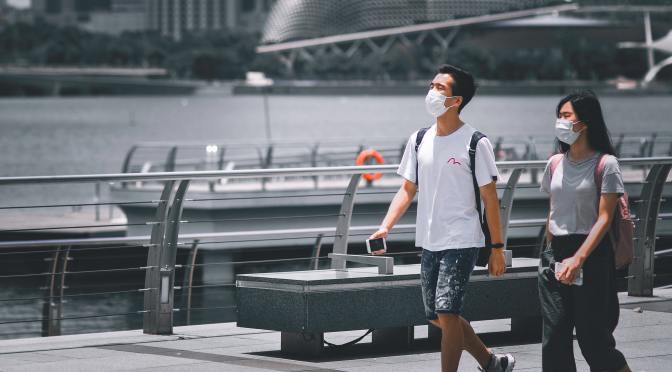
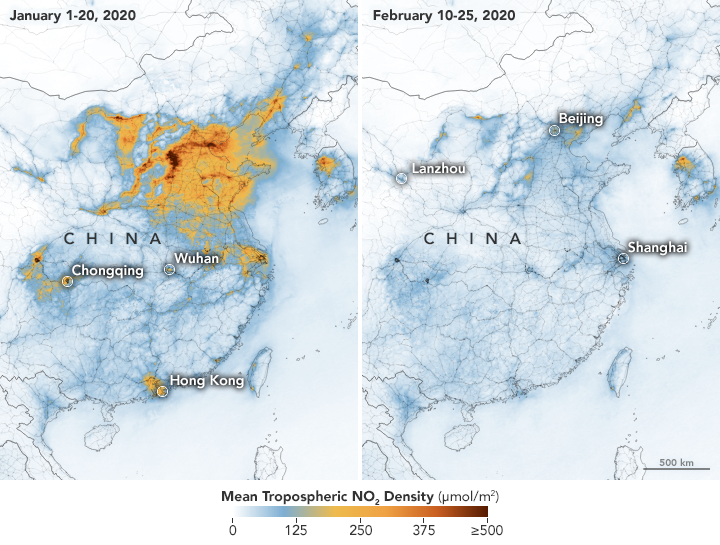
With Covid-19 reaching record numbers, our economy has sat at a stand still. But as the virus continues to threaten society, the environment seems to be thriving. In China, NASA and The European Space Agency collected data with pollution monitoring satellites observing a dramatic decrease in nitrogen dioxide (NO2) when comparing data from before quarantine and during quarantine. The slowdown of China’s economy decreased the use of major nitrogen dioxide producers like motor vehicles, power plants, and industrial facilities. This trend similarly occurred in Northern Italy and other metropolitans in the United States as Covid-19 spread.
“This is the first time I have ever seen such a dramatic drop-off over such a wide area for a specific event.”
– Fei Liu
Air quality researcher at Nasa’s Goddard Space Flight Center
Profesor John Helveston from The School of Engineering and Applied Science at George Washington University recently discussed his concern for a potential rebound affect of many economies around the world. He pointed out that after the 2008 financial crisis, many stimulus packages were given out from the government to stimulate the economy. This in turn lead to an increase of emissions that was more than would have occurred if the financial crisis did not happen. Unfortunately, Coronavirus dwarfs the impact of the 2008 financial crisis meaning that a quick stimulation of the world economy in 2020 could have an even more drastic effect on emissions.
This was not the situation intended to start the discussion about emission reduction. It is disturbing to see that an inadvertent virus had to occur to dramatically decrease emissions back to the 2006 levels because our fight for emission reduction should be a choice we make on our own. Coronavirus has had a positive effect on emission reduction, but only we can control if the positive change continues after Covid-19 passes.
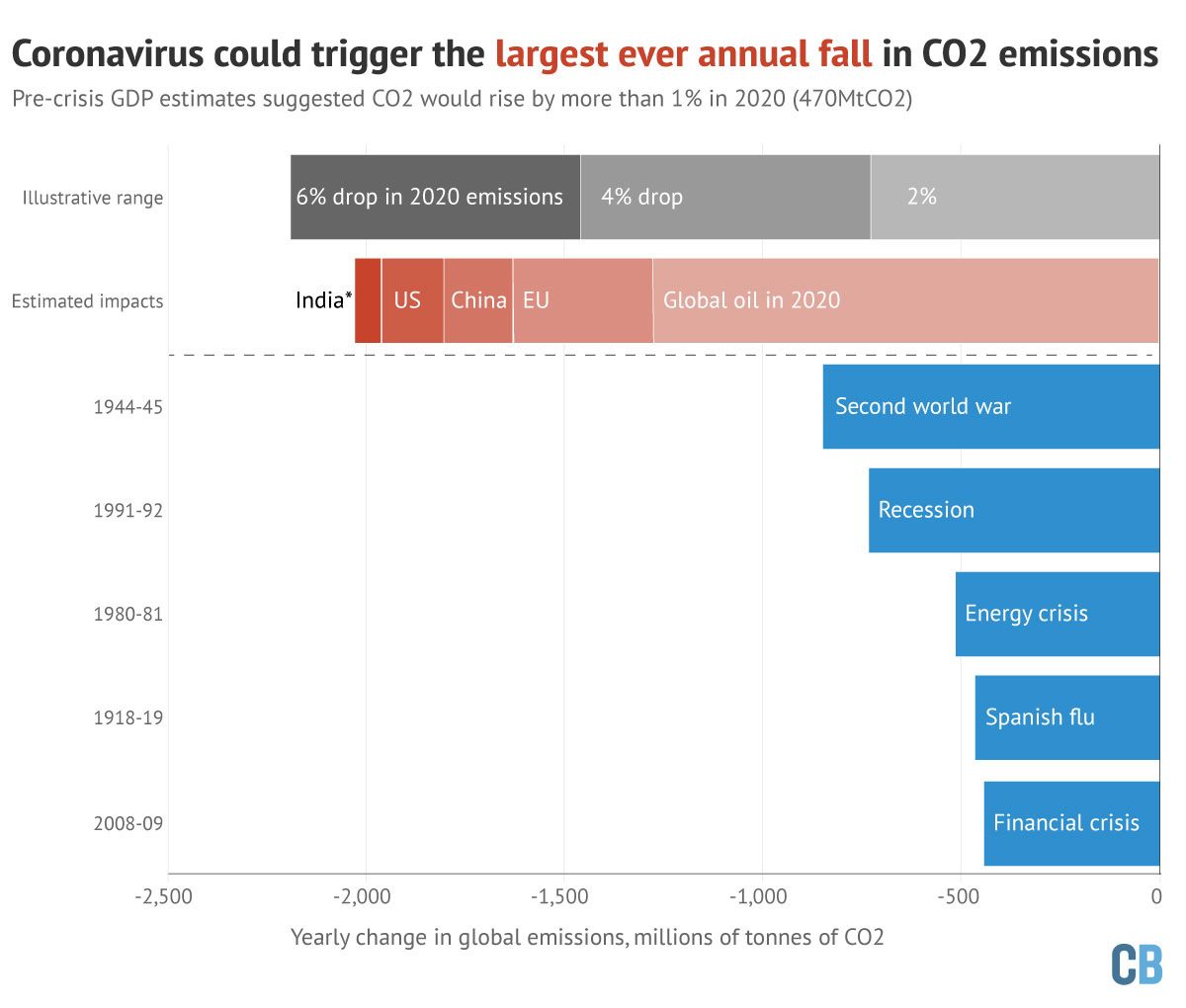
World carbon emissions in 2020 is predicted to fall anywhere from 4% to 8% compared to 2019. The Paris climate agreement and the United Nations Gap report state that global emissions must fall by between 3% and 7% each year by 2030 to limit climate change well below 2℃ and 1.5℃. The predicted carbon emissions drop in 2020 could meet this target despite all the wrong reasons.
2021 could quickly bring back normality to our economy and we would be back on the path towards increased emissions. But taking from what we have seen during the 2008 financial crisis and Covid-19, we could reach economic recovery through clean air technologies. These investments would increase economic competition, create jobs, and pave the path for a clean and long lasting future. Whether Coronavirus becomes an event that further threatens the earth or instead thrives to help it is a decision that will have a long term impact. Let’s focus on creating progress towards a cleaner world.
Ways to help the progress continue
Coronavirus is not a sustainable plan to help global emissions decrease. It’s our time to take action. Here is what we can do to make sure the world economy recovers while also continuing to reduce the environmental effect in the long run.
- Travel less, create a green commute
- public transit
- bike or advocate for bike lanes in your community
- car-share or carpool
- electric or plug-in hybrid vehicle
- fly less or try to offset your emissions
- Be smart when using energy
- pick an electric stove over a gas stove, reduces indoor pollution
- unplug items when not in use
- wash clothes in cold water and hang-dry
- research the energy use of appliances before buying
- winterize your home to keep heat from escaping
- home or workplace energy audits can help identify where you could be saving energy
- Transition to more renewable energy sources in your home
- Create a climate friendly diet
- Eat or cook more meat-free meals
- Buy organic and local
- Don’t waste food
- Grow your own
The biggest sources of global emissions takes actions from governments and industries leaders
Here are plans we as individuals cannot accomplish without our government and industry leaders. But we can raise awareness and increase discussions about these topics to pressure action from higher authorities.
- Discuss plans for a clean air ordinance or contingency
- Be politically active and vote
- support Congressional candidates fighting against climate change
- vote out and oppose the ones who don’t
- Urge Ottawa to support a green recovery
- click the button to sign the petition

 The Educated Consumer